
Bank Guarantees and Post-Dated Cheques: Stop Using a Register
Stop managing bank guarantees and post-dated cheques in registers. Use ERP software to track payments, expiry dates, statuses, and financial commitments in one place.
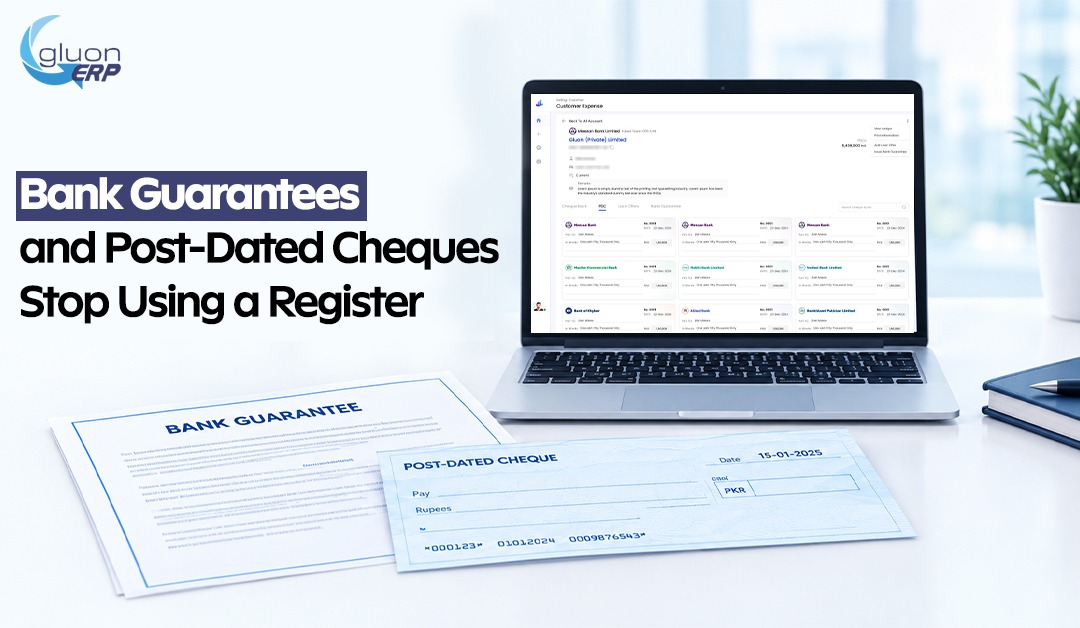
Bank Guarantees and Post-Dated Cheques: Stop Using a Register
For many businesses, bank guarantees and post-dated cheques are still managed through a physical register, Excel sheet, or separate files.
At first, this may seem manageable. But as the business grows, the number of cheques, guarantees, customers, suppliers, and transactions increases. Suddenly, a simple register becomes difficult to maintain.
A cheque has a future date. A bank guarantee has an expiry date. A payment needs to be tracked. A document may need to be renewed or released.
The real question is not “Where is the register?”
It is:
“What is the current status of every financial commitment?”
This is where ERP software for finance and accounting can replace manual tracking with a connected digital process.
Why Post-Dated Cheques Need Proper Tracking
A post-dated cheque (PDC) is issued with a future date and is commonly used in business transactions for customer payments, supplier payments, installments, and credit arrangements.
The problem is that receiving a cheque does not mean the payment has been completed.
The finance team may need to track whether the cheque is:
- Received
- Pending
- Deposited
- Cleared
- Returned
- Cancelled
- Replaced
When this information is maintained in a register, keeping it updated depends entirely on manual entries.
A PDC management system can make this process easier by keeping cheque details, dates, amounts, parties, and statuses connected to the relevant financial transaction.
A Register Shows the Cheque. A System Shows Its Status.
Imagine your company has 300 post-dated cheques.
A traditional register may tell you:
Cheque No. 10245 — Rs. 500,000 — 15 October
But the finance team may still need to find out:
- Has it been deposited?
- Has it cleared?
- Which invoice is it linked to?
- Is the customer's balance updated?
- Was the cheque returned?
- What action is required?
This is the difference between a PDC register and digital cheque management.
A modern accounting ERP system can connect the cheque with the customer, invoice, payment, and ledger, giving finance teams a clearer view of the complete transaction.
Bank Guarantees Are More Than Documents
The same problem exists with bank guarantees.
Businesses may use bank guarantees for contracts, tenders, projects, advance payments, performance obligations, and other commercial transactions.
A bank guarantee can involve important information such as the guarantee amount, beneficiary, issuing bank, issue date, expiry date, contract reference, and renewal or release requirements.
If this information is sitting inside a physical file or Excel sheet, the business still has to remember when action is required.
That can create unnecessary risk.
A bank guarantee management system helps businesses maintain these details in a centralized digital record and monitor important dates and statuses.
Don't Let an Expiry Date Become a Surprise
Consider a bank guarantee that is due to expire next month.
The original document is safely stored in a file.
But if nobody is actively monitoring the expiry date, the business may discover the issue only when renewal or release action becomes urgent.
This is why bank guarantee tracking should be part of financial management rather than simply document storage.
With an ERP system, finance teams can maintain guarantee information and monitor upcoming dates instead of relying only on manual registers and reminders.
Connect PDCs With Customer Accounts
One of the biggest advantages of ERP accounting software is that financial information does not have to exist in isolation.
For example, a customer transaction can follow a connected process:
Customer Invoice → PDC Received → Cheque Date → Deposit → Clearance → Customer Ledger
Instead of recording the invoice in one place and the cheque in another, the information can remain connected.
This gives the finance team a better understanding of what has been received, what is pending, and what has actually been cleared.
Connect Payments With Supplier Accounts
The same approach can be used for supplier payments.
A business may issue a post-dated cheque against a supplier invoice.
The process can be tracked as:
Supplier Invoice → PDC Issued → Cheque Date → Presentation → Clearance
This gives businesses better visibility into upcoming payment commitments and supports more organized accounts payable management.
Better Visibility Into Cash Flow
Post-dated cheques are closely connected to future cash movements.
However, an issued or received cheque is not the same as a cleared bank transaction.
For this reason, businesses need to distinguish between expected payments, expected receipts, pending cheques, and completed transactions.
A financial management system can help management understand upcoming cash movements and outstanding commitments more clearly.
This becomes increasingly important for growing businesses with large customer bases, multiple suppliers, and high transaction volumes.
Stop Maintaining Separate Registers
As a business grows, finance teams may end up maintaining separate records for:
- Customer payments
- Supplier payments
- PDCs received
- PDCs issued
- Bank guarantees
- Invoices
- Customer balances
- Supplier balances
The problem is not only the amount of data.
It is the lack of connection between that data.
A modern ERP system in Pakistan can bring these financial activities into one connected environment.
Instead of moving between registers, spreadsheets, emails, and files, finance teams can work with centralized financial information.
What Should a Modern PDC Management System Track?
A useful post-dated cheque management system should allow businesses to maintain important information such as:
Cheque Details:
Cheque number, bank, amount, cheque date, issue date, and party.
Transaction Details:
Related invoice, customer or supplier, payment reference, and account.
Cheque Status:
Received, issued, deposited, cleared, returned, cancelled, or replaced.
Financial Information:
Outstanding balance, payment status, and related ledger information.
This turns cheque tracking from a simple register into a structured financial process.
What Should Bank Guarantee Software Track?
For bank guarantee management, businesses should be able to record:
Guarantee Details:
Guarantee number, amount, type, issuing bank, and beneficiary.
Validity:
Issue date, expiry date, renewal details, and current status.
Business Reference:
Related customer, supplier, project, contract, or transaction.
Supporting Information:
Relevant documents, correspondence, release information, and other references.
Having this information in one system makes it easier for finance teams to review active and upcoming guarantees.
From Manual Tracking to Digital Financial Management
The purpose of ERP software is not simply to replace a paper register with a digital screen.
The bigger advantage is connected financial management.
Your sales invoice can connect with the customer account.
Your customer account can connect with the PDC.
The PDC can connect with the payment.
The payment can update the ledger.
The same principle can apply to purchases, supplier payments, and bank guarantees.
This creates a more complete picture of the business's financial position.
How Gluon ERP Helps
Gluon ERP brings finance and accounting together with other core business functions, including sales, purchase, inventory, manufacturing, CRM, distribution, and reporting.
For businesses managing post-dated cheques, customer payments, supplier payments, and financial transactions, the goal is to reduce scattered records and create better visibility across business operations.
Instead of asking your finance team to check multiple registers, spreadsheets, and files, an integrated ERP accounting system provides a more connected way to manage business information.
The goal is simple:
Know what is received.
Know what is due.
Know what has cleared.
Know what needs attention.
Book A Free Demo with Gluon ERP.
Request Your Free
Gluon ERP Demo



and ERP insights delivered to your inbox.


